The Framework

Governance built into the system, not applied after the fact.

Governance by Design™ is a governance architecture framework that establishes accountability as a structural, load-bearing property of any system that makes consequential decisions at scale. It applies universally — whether the system is an AI credit decisioning model, a clinical decision support platform, a government benefits determination engine, a financial trading algorithm, or a military command and control system. The framework is sector-agnostic and implementation-neutral. Stronghold™ is Cedar Fort Digital’s reference implementation; the framework specification itself is published openly to support consideration as a recognized governance standard.

01 — The problem

Governance designed for a world that no longer exists.

Every institution operating AI systems, automated decision engines, or agentic technology faces the same structural failure: governance designed for human-paced processes cannot govern systems operating at machine speed.

Periodic sampling, manual evidence collection, and point-in-time validation were appropriate when decisions could be examined individually. They are structurally inadequate when systems make thousands of consequential decisions per hour.
The result is an accountability void. The institution cannot prove what happened. The regulator cannot verify compliance. The individual affected has no recourse to an auditable record.

This is not a technology problem. It is an architecture problem.

02 — Core thesis

The principle the framework is built on.

Governance must be a structural property of every consequential decision system, not a supervisory layer applied to it. Human judgment is not an exception path. It is part of the design.

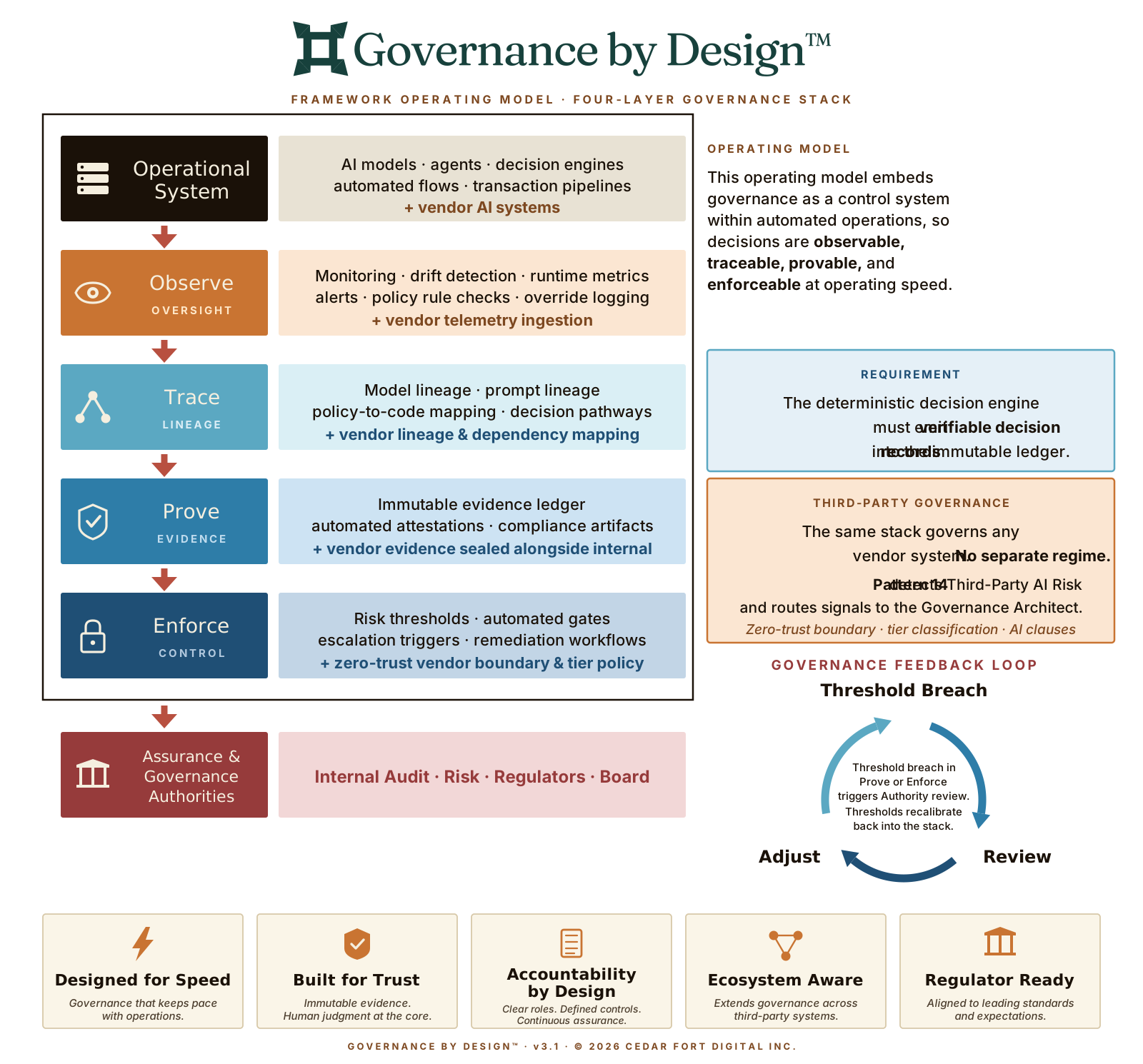
Governance by Design framework diagram showing the operational system feeding Observe, Trace, Prove, Enforce, with the Assurance Authority at the top.
Exhibit 01 — Governance by Design™ reference architecture.
03 — The four functions

Four governance functions, active at once.

I.

Observe

Continuous oversight of the operational system — monitoring, drift detection, runtime metrics, alerts, policy rule checks, override logging.

II.

Trace

Lineage across model, prompt, and policy-to-code mapping. Decision pathways and system state transitions captured as they happen.

III.

Prove

Immutable evidence ledger, automated control attestations, and compliance evidence generation — produced as work happens.

IV.

Enforce

Risk thresholds, automated gates, escalation triggers, deployment controls, and remediation workflows.

04 — Human Factor Framework™

Human judgment is structural, not optional.

The Human Factor Framework™ defines when human judgment is required, what context the system must provide to support it, and what record must be generated to prove that judgment was exercised.

The Human-in-the-Loop protocol is not a workaround. It is a designed accountability checkpoint that preserves human authority at the precise moments when it matters most.

Human in the Loop

A designed accountability checkpoint.

Human judgment is not an exception path. It is part of the design.

05 — For the profession

Restore professionals to the work they were trained to do.

Governance by Design™ is built on a practical premise: professionals in any position of institutional trust — internal auditors, underwriters, clinicians, credit analysts, government caseworkers, intelligence officers, compliance officers — should spend less time on manual evidence collection, retrospective reconstruction, and administrative burden, and more time on interpreting signals, exercising judgment, shaping better controls, and improving the system before failure occurs.

The framework does not reduce the value of human oversight. It restores it to its proper place.

06 — The framework specification

The framework, in 34 pages.

Governance by Design™ is published openly so that institutions, regulators, standards bodies, and conforming implementers can evaluate the architecture on its merits.

The specification covers the four-layer governance stack, the Pattern Object Model™, the Human Factor Framework™, the Evidence Chain, and the Policy-Control Identity property — and maps to IIA 2025, ISO/IEC 42001, NIST AI RMF, NIST SP 800-53, and NIST SP 800-161 at requirement level.

34 pages · Confidential & Proprietary · May 2026

See Governance by Design™ running in a real governed environment.

The Suite

Continue exploring.

Five components. One governed operating environment.